
By Mr. Maverick
Arithmology oscillates between numerology and mathematics. It stands, in other words, at the intersection between science and pseudoscience. It’s a strange but fascinating field, attempting to explore the hidden meanings and symbolic significance attributed to some numbers, meanings that extend beyond their pure quantitative properties.
Number three, for instance, is quite absorbing for a number of reasons. There are three primary colors; there are three dimensions of space; every story consists, essentially, of three parts: beginning, middle, and end; humans tend to remember in threes, because this number provides a neurologically balanced combination of simplicity and complexity, creating an easily memorable and not overwhelming pattern.
Number three is enough to suggest multiplicity and pattern, the smallest number that feels like a whole system, rather than a simple pair. Three represents balance and, therefore, it’s safe to say that it holds cosmic significance. Cosmic, or, better yet, divine.
Heraclitus. The obscure philosopher. Obscure, at least during his age, because the more space time created between us, the more illuminating his words became. The gloom of his vagueness transformed into a blinding light of reason and unequivocal truth.
He was right, all along.
As he wandered in the majestic Greek city of Ephesus, his brilliant mind captured and articulated a universal principle of existence. An omnipresent, ageless principle, that proudly stands next to the enigmatic dimension of time itself.
Laconically, as he would fashion, we could sum up the essence of his idea in one felicitous sentence: the cosmos is defined by the dialectic interaction of opposites – the forces released by the attraction, repulsion, and collision of infinite dipoles.
Think about it for a moment. Every concept, idea, or word is contradicted by an opposite. We just mentioned one: attraction and repulsion. Acceleration and deceleration; expansion and contraction; action and reaction; order and chaos; excess and deficiency; limitlessness and restriction; suffering and liberation; evil and good; war and peace; unity and division, and so on and so forth. The list goes on to cover the entire conceivable universe.
A constant struggle, an antithesis, with the forces being produced forming existence itself. An endless tug-of-war between manifold opposites. Heraclitus was the first to encapsulate and crystallize this universal principle – an essential feature of cosmic creation. A world constantly in flux, always “becoming” but never “being.” A bi-directional energy resembling a constant wave-like motion, the direction or purpose of which remained a mystery. Similar to the geometrical expression of the repetitive struggle between action and reaction: the circle.
Through the multitude of the universe’s dipoles, one could argue that number two enjoyed the fruits of divine significance, as the representation of this perpetual life-generating process.
Yet a void continued to occupy our limited, nevertheless brilliant, human minds. The framework was incomplete.
– “Something’s missing,” reckoned consciousness.
– “I agree,” replied reason.
The strenuous philosophical quest to uncover the whole truth went, and continues to go, on ceaselessly until this day. A big question mark hovered above the heads of every generation’s greatest intellects.
“Why?”
“Why does this everlasting dialectic of opposites occur, shaping the trajectory of life, the way things evolve around us?”
“Where does this interaction derive from, and, if anywhere, where does it lead to?”
“Who pulls the strings in this show we call life?”
The revelation of the truth might have already taken place. Arrogant and hard-headed as we humans are, we turned a deaf ear to it. Our egotistical view of the world may once again have blinded us.
The missing piece of the puzzle is divinity or transcendence – expressed in the face of Christ. The arrival of Jesus Christ was, and continues to be, the raft in the ocean of the inexplicable and the consternation it invokes. The helping hand guiding us into the unknown. The description of the indescribable force driving the cosmic ebb and flow. The frequency to which the universal principle of rhythm is attuned. The process you trust.
In short, the apex. The third element – the element of harmony.
Christ is the embodiment of divinity. Of the “why?” intellects like Heraclitus stumbled upon. A symbolic incarnation, reminding us of the flawed, deficient human nature. His arrival epitomizes our humility. And humility is a precondition to reconcile with the hereafter, which rises above and beyond the grasp of our consciousness.
In his face, divinity serves as the third element of harmony in the principle of opposites. The glue that holds them together. God is the spirit – or universal mind, depending on your spiritual perspective – that oversees, permeates, and configures the dialectic of opposites, securing universal balance, the essential condition of being. God is the wise craftsman of the cosmic fabric. God doesn’t exist; God is.
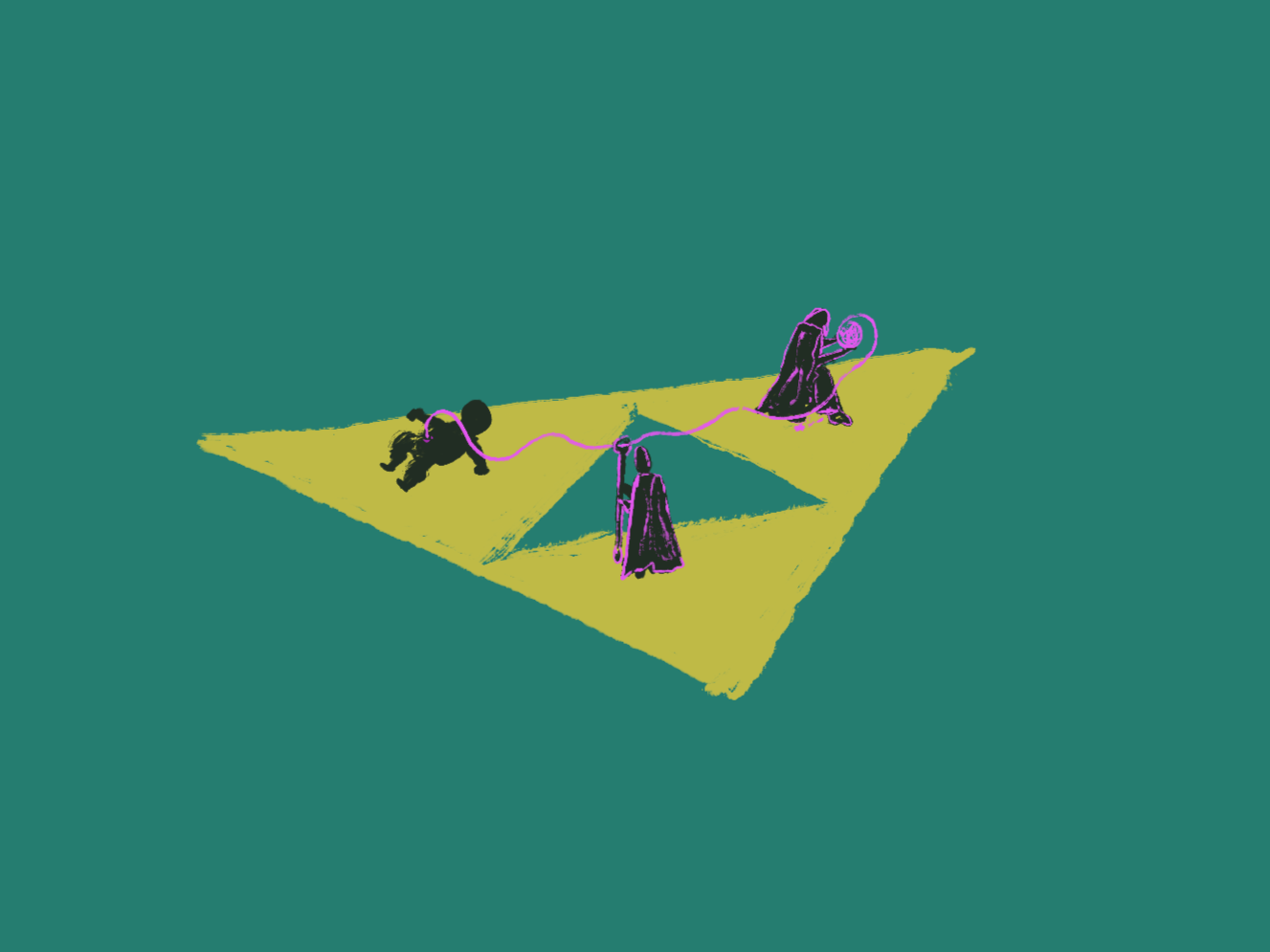
Through Christ, God bequeathed us, schematically, with the triangulation of the dialectic of the opposites. Alone, this endless reciprocation expressed a futile, incomprehensible repetitive process. It was imperceptible. The triangle, instead, imposed a pattern – a system – offering meaning to the process. It gave prominence to the universal mystery of triunity and revealed the power of the ever-present number three. God gives Heraclitus’ dialectic structure and purpose. God is the third commanding force, the nature and quality of which we cannot and, frankly, do not necessarily have to decipher. Our egotistical pathology should, for once, be suppressed before the omnipotence of higher forces and unfathomable concepts. After all, we are only equipped with a seed of consciousness – a fraction of wisdom. Humility is not weakness. On the contrary, it’s a powerful weapon: a vein to be mined for further spiritual upliftment, a shield against the sin of conceit and its pitfalls. As the principle of opposites dictates, we cannot rise if we don’t first hit rock bottom.
Humility, therefore, and faith in God’s intentions are immensely important. Because our capacity to overcome adversity is anchored entirely to the rigidity of our faith.
It doesn’t take much time, nowadays, to accept that modernity crushes, little by little, our society’s cherished sources of meaning. A strong faith in God engages, thus, contemporary sentiments and needs.
We need God. We need the number three. Without them, we are left adrift in Pascal’s ‘infinite abyss.’ Unmoored. Swallowed by merciless chaos.